


johndoe@gmail.com

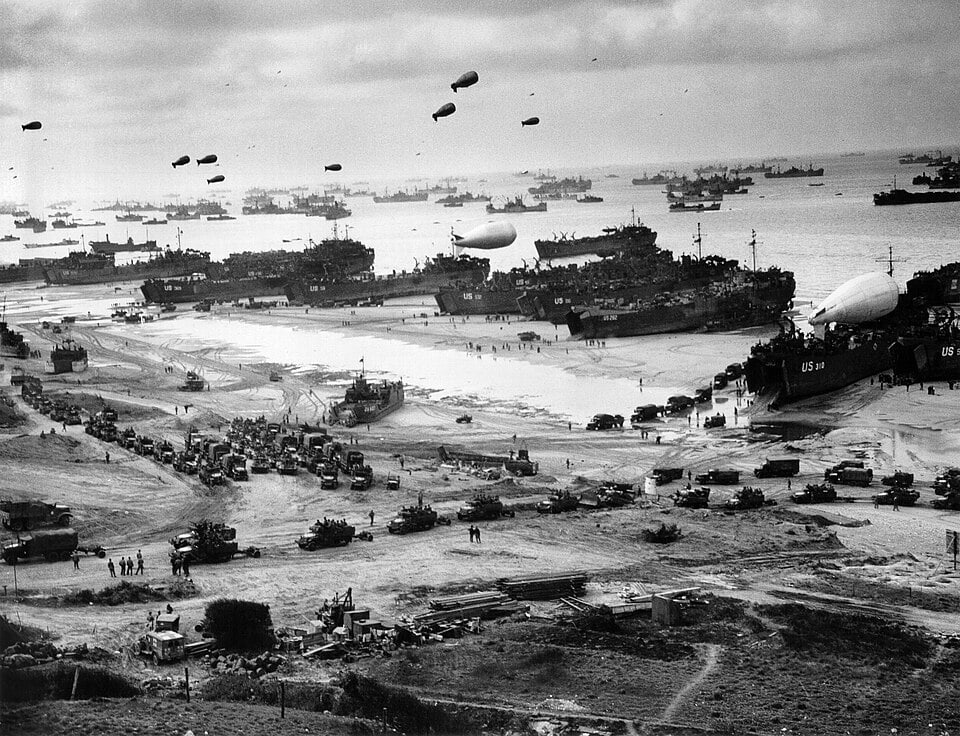
Landing ships putting cargo ashore on Omaha Beach at low tide during the early days of the Allied invasion, mid-June 1944. (Wikimedia Commons)
In the early stages of the Second World War, Nazi Germany dominated Europe. The invasion of Poland in 1939 was followed by a succession of German victories across northern Europe in 1940. By May of that year, the British Expeditionary Force (sent to aid France) had been forced back to Dunkirk and evacuated. France surrendered in June. At this point, a British re-invasion of France was impossible. In fact, Britain began preparations to defend itself from a possible German attack, establishing the Home Guard, constructing coastal pillboxes, and preparing beaches with tank traps.
A major turning point came in June 1941 when Germany invaded the USSR. From late 1941 onwards, Stalin urged Britain and the US to open a ‘Second Front’ in Western Europe to relieve the pressure on the Red Army. However, throughout 1942, the Allies disagreed over when and where to launch an invasion. The Americans were keen to begin plans but Churchill was more cautious, preferring to continue fighting Germany in the Mediterranean. He argued that an early invasion would be disastrous without air superiority and while German U-boats still posed a significant threat in the Atlantic.
However, by the end of 1942, the situation was shifting. Allied victories in North Africa and the Soviets halting the Garman advance at Stalingrad meant the Axis powers were now under considerable strain. Therefore, at the Casablanca Conference in January 1943, the Allies agreed to begin planning a cross-Channel invasion, later codenamed ‘Operation Overlord’.
The Allies now turned their attention to the enormous practical challenge of assembling the men, equipment, and logistical systems needed for an amphibious invasion. The Germans had been heavily fortifying the Atlantic coastline (the ‘Atlantic Wall’) since 1942. The risks of attacking such a heavily defended coast were made clear in August 1942 when the Allies attempted to raid Dieppe. Of the 6,086 troops who landed, 3,623 (overwhelmingly Canadian) were killed, wounded or captured. The lessons learned from the disaster at Dieppe shaped every aspect of Overlord, from the choice of location, to timing and logistics.
Specially trained men and women at the RAF’s photographic interpretation unit studied photographs of the coastline (gathered by Spitfire planes) to assess potential landing sites. Although the shortest crossing was from Kent to Calais, this area was anticipated as a likely invasion site by the Germans, and was very heavily defended. By mid-1943, Normandy had been selected, despite its longer and rougher sea crossing. It offered a favourable balance of suitable beaches, weaker defences, whilst still being within the range of fighter aircraft for support.
With the landing site chosen, planners focused on transporting and protecting the invasion force. Overlord would be the largest amphibious operation in history. Hundreds of thousands of troops would need to be carried across the Channel along with vehicles, weapons, fuel, food, and medical supplies. Hundreds of landing craft and a powerful naval escort were required, as well as overwhelming air superiority to take out the coastal defences and shield the landing forces. Many questioned whether such a vast assembly of manpower and material could ever be coordinated successfully.
Alongside these preparations, the Allies launched an elaborate deception operation – ‘Operation Fortitude’ – to convince the Germans that the invasion would come at Calais. False radio messages were sent out, a ‘phantom’ army was positioned in southeast England, and dummy tanks, aircraft, and buildings were constructed from inflatable rubber, wood, and canvas. Double agents fed this misinformation to German spies, reinforcing the illusion that Calais was the true target.
Meanwhile, the real preparations were under way across southern England, where troops gathered in secure marshalling areas. Planners closely monitored the weather, as the invasion required very specific conditions: a full moon, low tide, clear skies, and calm seas. General Dwight D. Eisenhower, Supreme Commander of Overlord, had initially set the date for the operation as 5 June 1944, but bad weather forced a postponement, and ‘D-Day’ finally took place on 6 June.
The invasion began before dawn with Allied air attacks on radar stations, rail networks, and bridges, cutting off the German defenders from reinforcements. Many of the air strikes were deliberately directed away from the landing zone to create confusion.
Around 24,000 troops were dropped from planes or landed in gliders behind enemy lines. Their task was to seize key bridges, road junctions, and coastal defences, in order to protect the flanks of the landing forces and slow down German reinforcements. To further mislead the enemy, the Allies dropped dummy parachutists made of cloth and straw in four different locations across Normandy, while aircraft released metal foil (chaff) to confuse German radar, making it seem like a larger force was landing from Dover. German commanders were successfully convinced that Normandy was a diversion, and held back tanks and troops near Calais.
At sea, nearly 7,000 vessels supported the invasion. Sailors transported the troops across the Channel, protected them from German attacks, and continuously bombarded the German defences. By the end of the day, approximately 132,000 British, American, and Canadian troops had crossed by sea.
The landings took place on five beaches, each one given a code name. In the west, the Americans assaulted Utah and Omaha; and in the east, the British and Canadians landed at Gold, Juno, and Sword. Success varied greatly. At Utah, American troops landed slightly off course but met limited resistance and secured the beach quickly. At Omaha, however, steep cliffs and intact German defences resulted in extremely heavy casualties before the beachhead was finally established. On the British and Canadian beaches, progress inland was steady despite strong resistance, especially at Juno.
By nightfall, around 155,000 Allied soldiers were ashore. Casualties, although heavy – between 7,000 and 11,000, including over 4,000 dead – were lower than the most pessimistic forecasts, which had predicted as many as 10,000 deaths. The initial beachheads were smaller than planned, but supplies were coming ashore. Of course, D-Day marked only the beginning of the long campaign to liberate Western Europe, but it represented a decisive turning point in the war and the essential first step toward defeating Nazi Germany.
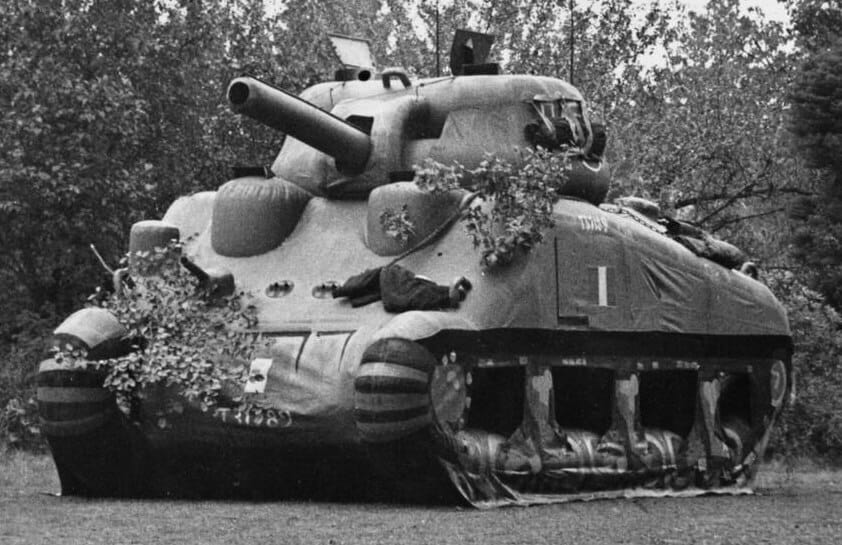
An inflatable "dummy" M4 Sherman. (Wikimedia Commons)
➜ Jeremy Black on Churchill as a strategist during World War Two*
➜ BBC History Extra – Churchill’s evolving perspective on D-Day (requires BBC History Extra subscription)
➜ Teaching With Documents: “A Date Which Will Live in Infamy” from the US National Archives and Records Administration
➜ BBC Bitesize – How was the biggest ever seaborne invasion launched?
➜ BBC Bitesize – planning D-Day
➜ The Imperial War Museum – The story of D-Day by the people who were there
➜ The Commonwealth War Graves Commission – The Untold Stories of D-Day Veterans
➜ BBC History Extra – The women’s work that made D-Day a success (requires BBC History Extra subscription)
➜ Military History Matters – Book review of Sarah-Louise Millers’s The Women Behind the Few: the Women’s Auxiliary Air Force and British Intelligence during the Second World War
➜ The National WWII Museum, New Orleans – video on the 320th Barrage Balloon Battalion, a unit of African American soldiers during World War II that served on D-Day
*This page requires a subscription to the Churchill Archive. Click here to request free access for secondary schools and Sixth Form colleges.


