


johndoe@gmail.com

...
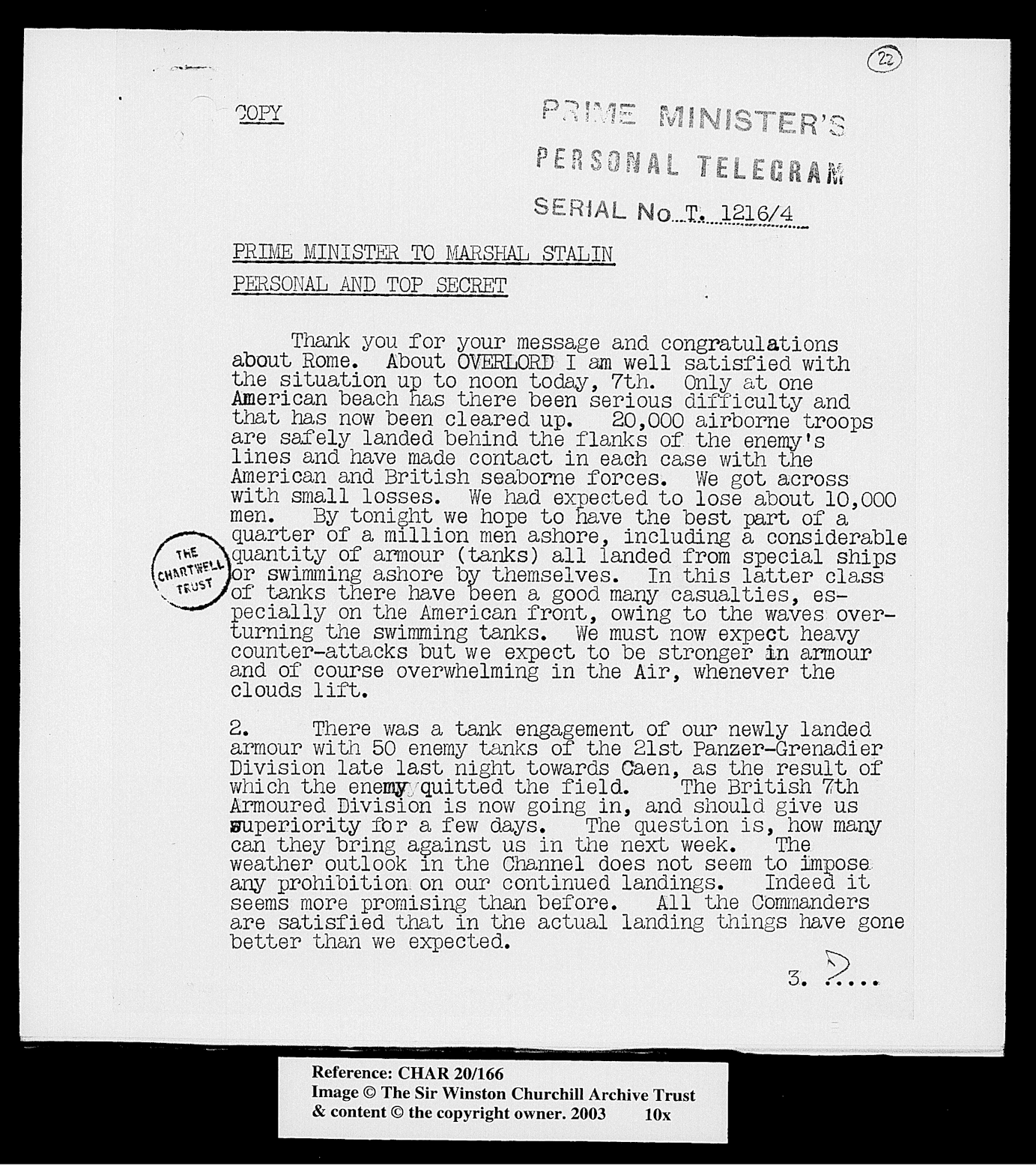
Thank you for your message and congratulations about Rome. About OVERLORD I am well satisfied with the situation up to noon today, 7th. Only at one American beach has there been serious difficulty and that has now been cleared up. 20,000 airborne troops are safely landed behind the flanks of the enemy's lines and have made contact in each case with the American and British seaborne forces. We got across with small losses. We had expected to lose about 10,000 men. By tonight we hope to have the best part of a quarter of a million men ashore, including a considerable quantity of armour (tanks) all landed from special ships or swimming ashore by themselves. In this latter class of tanks there have been a good many casualties, especially on the American front, owing to the waves overturning the swimming tanks. We must now expect heavy counter-attacks but we expect to be stronger in armour and of course overwhelming in the Air, whenever the clouds lift.
2. There was a tank engagement of our newly landed armour with 50 enemy tanks of the 21st Panzer-Grenadier Division late last night towards Caen, as the result of which the enemy quitted the field. The British 7th Armoured Division is now going in, and should give us superiority for a few days. The question is, how many can they bring against us in the next week. The weather outlook in the Channel does not seem to impose any prohibition on our continued landings. Indeed it seems more promising than before. All the Commanders are satisfied that in the actual landing things have gone better than we expected.
3. Most especially secret. We are planning to construct very quickly two large synthetic harbours on the beaches of this wide sandy bay of the Seine estuary. Nothing like these have ever been seen before. Great ocean liners will be able to discharge and run by numerous piers supplies to the fighting troops. This must be quite unexpected by the enemy and will enable the build-up to proceed with very great independence of weather conditions. We hope to get Cherbourg at an early point in the operations.
4. On the other hand, the enemy will concentrate rapidly and heavily and the fighting will be continuous and increasing in scale. Still, we hope to have by D. + 30 about 25 divisions deployed with all their corps troops, with both flanks of the second front resting on the sea and possessed of at least three good harbours, Cherbourg and the two two synthetic harbours. This front will be constantly nourished and expanded, and we hope to include later the Brest Peninsula. But all this waits on the hazards of war which, Marshal Stalin, you know so well.
...
Extracts from a telegram sent to the leader of the USSR, Joseph Stalin, from Churchill on 7 June 1944.
This is a telegram from Prime Minister Winston Churchill to the leader of the USSR (Joseph Stalin) on 7 June 1944. Churchill is reporting on the progress of the D-Day landings.
Britain, the United States, and the Soviet Union had been allies since Germany invaded the USSR in 1941. Stalin had been under huge pressure on the Eastern Front and had long been asking the Western Allies to open a ‘second front’ in Western Europe to relieve German attacks on Soviet forces. Operation Overlord, the D-Day landings in Normandy, finally opened this front. Although not involved in the military planning, Stalin was kept informed about scheduled date for the invasion. Churchill sent this telegram the day after D-Day to update him on the progress of the landings.
Remember, we are investigating why the Normandy Landings were such a remarkable achievement, including the risks involved in planning and executing them. This source can help us understand the obstacles the Allies overcame successfully on D-Day itself, and also remind us of the challenges and risks that remained after the landings.
Which of the inferences below can be made from this source?
| On a scale of 1-5 how far do you agree that this source supports this inference? | Which extract(s) from the source support your argument? | |
|---|---|---|
| What does Churchill say this depends on? | | |
| The Allies got ashore on D-Day with no problems. | | |
| Luck had nothing to do with the success of D-Day. | | |
| By the end of D-Day, the hard work was all done. | | |
Explore the guide to interpreting telegrams


