


johndoe@gmail.com

...
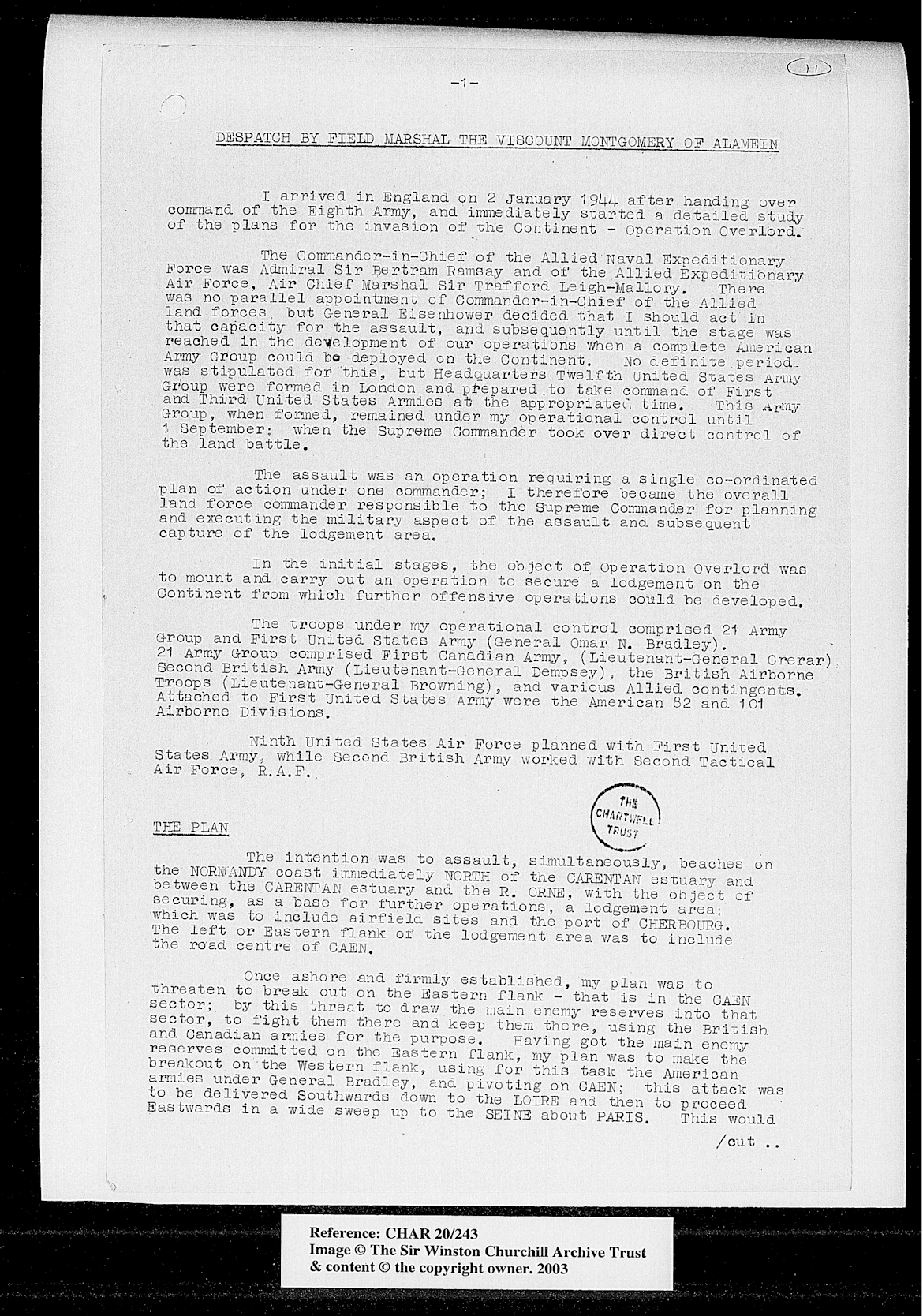
I arrived England on 2 January 1944 after handing over command of the Eighth Army, and immediately started a detailed study of the plans for the invasion of the Continent — Operation Overlord.
...
The intention was to assault, simultaneously, beaches on the NORMANDY coast immediately NORTH of the CARENTAN estuary and between the CARENTAN estuary and the R. ORNE, with the object of securing, as a base for further operations, a lodgement area: which was to include airfield sites and the port of CHERBOURG. The left, or Eastern flank or the lodgement area was to include the road centre of CAEN.
...
...
The NORMANDY beaches were selected because they offered a better shelter for shipping and were less heavily defended than other possible beach areas along the Channel coast. They satisfied the minimum requirements of the Air Forces, in terms of their distance from home bases, for the provision of air cover.
The absence of major ports was overcome by the gigantic engineering feat of constructing two artificial ports in the UK; these were towed across the Channel in sections and erected, one in the U.S. sector and one in the British sector. In spite of considerable damage during the unprecedented June gale, the port at ARROMANCHES in particular proved a great success.
The invasion operations may be said to have begun with the action of the Air Forces. The first stage was the gaining of air superiority, an essential preliminary always to all major offensive operations. This task was admirably accomplished. As D-Day drew nearer, attacks were delivered against coast defences along the whole length of the ATLANTIC WALL. Meanwhile, prevention of enemy air reconnaissance during the period of concentration of the invasion forces was highly successful and contributed towards the gaining of tactical surprise.
...
...
For several years the Germans had been developing the coastal defence organisation which was known collectively as the ATLANTIC WALL. The enemy assumed that an invader would have to secure a port either in the initial assault or very quickly afterwards, in order to land the heaviest types of equipment and oragnise maintenance and supply. Port areas were therefore given first priority for defence, and by 1944 had become virtually impregnable to seaward as sault. After the ports, attention was turned to- the PAS de CALAIS, which bordered the narrowest part of the Channel and was considered the most likely area we would choose for the assault.
Elsewhere defences were on a less organised scale, for by the beginning of 1944 the enemy had not had the resources or transport to put the whole coast line in a uniform state of defence. From March, 1944, however, there was a most noticeable intensification of the defences in NORAMNDY: following a tour of inspection by Rommel.
The coastal defence of the BAIE de la SEINE was based on a system of linear defences, arranged in strong points which were manned chiefly by static coastal troops of low category. The gun positions and localities were protected by concrete and armour from naval gunfire and air attack; extensive use had been made of minefields, wire entanglements, and other obstacles to strengthen the layout. Extensive flooding of the low-lying areas in the coastal belt had been effected, particularly in the marshy country round the CARENTAN estuary. Existing sea walls had been strengthened and prolonged to form anti-tank obstacles behind the beaches, which themselves were extensively mined. On the beaches, and extending over varying distances below high water mark, were belts of under-water obstacles, the purpose of which was to halt and impale landing craft and to destroy or cripple them by means of explosive charges attached to the individual obstacles; types of under-water obstacles included 'Element "C"' with Tellermines on the forward face, the ramp type wooden obstacle with Tellermines on the top of the ramp, wooden posts with Tellermines attached, steel hedgehogs and steel tetrahedra.
The enemy artillery defence consisted of long range coast artillery and field artillery. The former was sited well forward, covering in particular the entrances to CHERBOURG, the CARENTAN estuary and the SEINE. Heavy gun batteries located in the CHERBOURG area and round LE HAVRE almost overlapped in range, and presented the gravest danger to the approach of all large vessels to the transport area off the NORMANDY beaches. Behind the coast artillery, some two or three miles inland, field and medium artillery units of the divisions occupying the coastal sectors were sited; the task of these guns was to bring fire to bear on craft approaching the beaches and on to the beaches themselves. In all there were some thirty-two located battery positions capable of firing on the assault beach areas.
...
Flooding became more extensive. Anti-air-landing obstacles commenced to appear on our air photographs in the most suitable dropping and landing areas; they consisted of vertical poles and stakes, and in some cases were fitted with booby traps.
...
I arrived England on 2 January 1944 and immediately started studying the plans for Operation Overlord.
The plan was to assault beaches on the NORMANDY coast with the aim of securing a base for further operations, including the port of CHERBOURG.
The NORMANDY beaches were chosen because they were less heavily defended than other areas along the Channel coast but still within range of our Air Forces.
Normandy did not have a major port, but this was solved by building two artificial ports in the UK. These were towed across the Channel and set up, one for the U.S. beaches and one for the British beaches. This was a huge achievement in terms of engineering.
The first stage was to make sure the Allied air forces controlled the skies and this had been achieved by D-Day. This meant that, as D-Day drew nearer, the Germans’ coastal defences were attacked. The enemy was also successfully prevented from spying on our invasion forces.
For several years the Germans had been developing the coastal defence system which was known collectively as the ATLANTIC WALL. Though NORMANDY was less well defended (the enemy assumed that an invasion was more likely near a port area), there was an intensification of the defences in the area after March 1944.
There were heavy fortifications manned by soldiers. Guns were protected with concrete and armour. The Germans had added minefields, wire fences, and other obstacles. They also flooded low-lying areas. Sea walls were reinforced and extended to act as anti-tank obstacles behind the beaches, which were themselves heavily mined.
On the beaches (covered by the water at high tide), were underwater obstacles designed to stop or destroy landing craft, including steel ‘hedgehogs’ and wooden ramps and posts loaded with explosives.
The German defences also included long-range coastal guns and field guns. The heavy guns had a range which could reach our large ships which would be anchored off the Normandy beaches, unloading the soldiers. The German field and medium guns were 2–3 miles inland and could fire on boats approaching the beaches and even on the beaches themselves.
The Germans also put up anti-air landing obstacles in the areas where planes or gliders might land. These were vertical poles and stakes, some fitted with booby traps.
This is a report written by Field Marshal Montgomery in 1945. Montgomery was the commander of the 21st Army Group, which included the main British and Canadian forces involved in the Normandy landings.
These extracts focus on the planning of D-Day and describe what the Allies knew about the German defences along the Normandy coast.
These extracts focus on the planning of D-Day and describe what the Allies knew about the German defences along the Normandy coast.
Remember we are hoping that this source can be useful to us in investigating why the Normandy Landings were such a remarkable achievement. So we’re looking for:
Which of the inferences below can be made from this source?
| On a scale of 1-5 how far do you agree that this source supports this inference? | Which extract(s) from the source support your argument? | |
|---|---|---|
| It was a priority for the Allies to control the skies before they could launch an invasion. | | |
| It was a huge problem that Normandy did not have a port. | | |
| The Normandy coast was extremely well defended. | | |
| On D-day, the soldiers landing on the beaches would be in the most danger out of everyone. | | |
Explore the guide to interpreting letters
➜ Source 3


