


johndoe@gmail.com

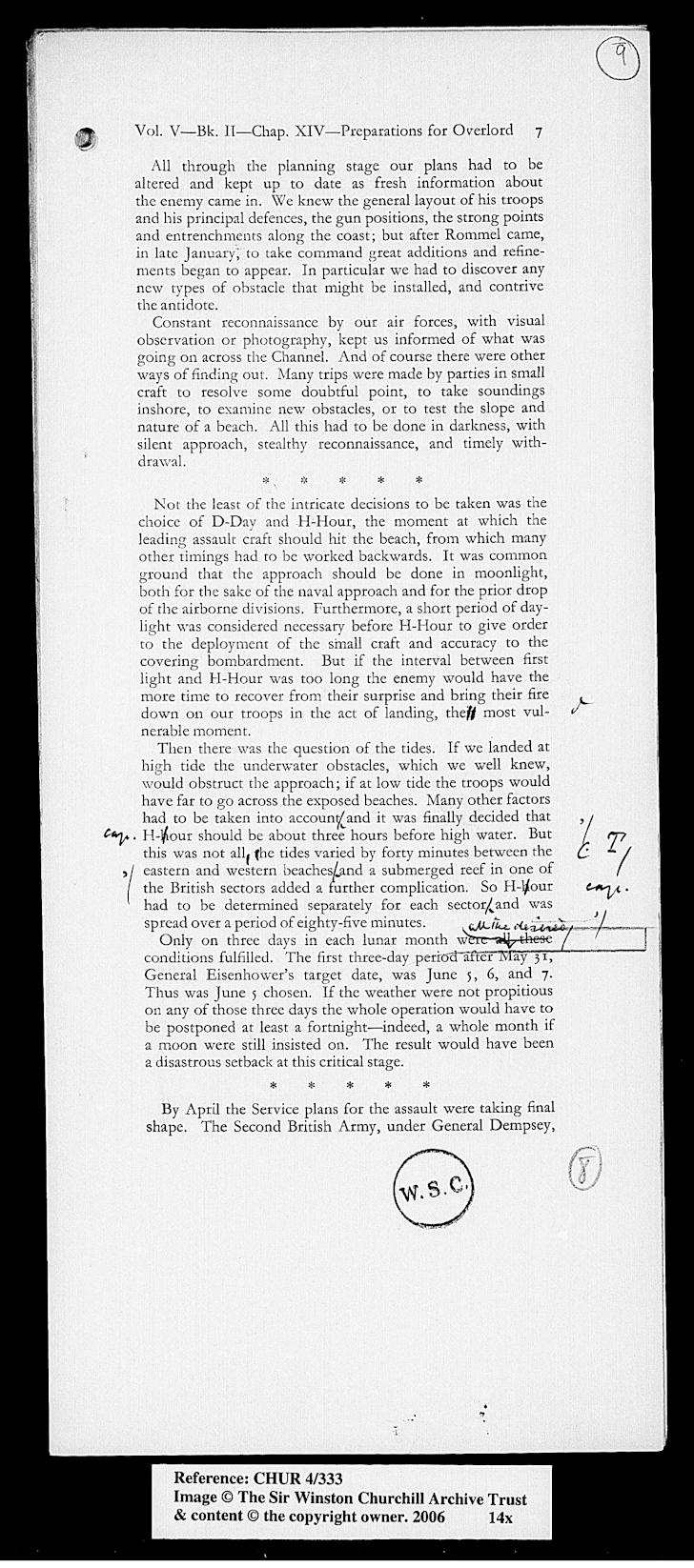
...
Constant reconnaissance by our air forces, with visual observation or photography, kept us informed of what was going on across the Channel. And of course there were other ways of finding out. Many trips were made by parties in small craft to resolve some doubtful point, to take soundings inshore, to examine new obstacles, or to test the slope and nature of a beach. All this had to be done in darkness, with silent approach, stealthy reconnaissance, and timely withdrawal.
Not the least of the intricate decisions to be taken was the choice of D-Day and H-Hour, the moment at which the leading assault craft should hit the beach, from which many other timings had to be worked backwards. It was common ground that the approach should be done in moonlight, both for the sake of the naval approach and for the prior drop of the airborne divisions. Furthermore, a short period of daylight was considered necessary before H-Hour to give order to the deployment of the small craft and accuracy to the covering bombardment. But if the interval between first light and H-Hour was too long the enemy would have the more time to recover from their surprise and bring their fire down on our troops in the act of landing, their most vulnerable moment.
Then there was the question of the tides. If we landed at high tide the underwater obstacles, which we well knew, would obstruct the approach; if at low tide the troops would have far to go across the exposed beaches. Many other factors had to be taken into account, and it was finally decided that H-Hour should be about three hours before high water. But this was not all; the tides varied by forty minutes between the eastern and western beaches, and a submerged reef in one of the British sectors added a further complication. So H-Hour had to be determined separately for each sector, and was spread over a period of eighty-five minutes.
Only on three days in each lunar month were these conditions fulfilled. The first three-day period after May 31, General Eisenhower’s target date, was June 5, 6, and 7. Thus was June 5 chosen. If the weather were not propitious on any of those three days the whole operation would have to be postponed at least a fortnight—indeed, a whole month if a moon were still insisted on. The result would have been a disastrous setback at this critical stage.
...
...
Of course we had not only to plan for what we were really going to do. The enemy were bound to know that a great invasion was being prepared; we had to conceal from him the facts and deceive him as to the place and time of attack. This alone involved an immense amount of thought and action. Coastal areas were banned to visitors; censorship was tightened; letters after a certain date were held back from delivery; even the diplomatic bags of foreign embassies were delayed.…
The major deception was to pretend that we were coming across the Straits of Dover. It would not be proper even now to describe all the methods employed to mislead the enemy, but the obvious ones of heavy concentrations of troops in Kent and Sussex, of fleets of small craft collected in the Cinque Ports, of landing exercises on the near-by beaches, of increased wireless activity, were all used.
More reconnaissances were made at or over the places we were not going to than at the places we were. The final result was admirable. The German High Command firmly believed the evidence we obligingly put at their disposal. Rundstedt, the Commander-in-Chief on the Western Front, was convinced that the Pas de Calais was our objective.
...
Our air forces constantly kept watch on the enemy and analysed photographs to keep us informed about activity across the Channel. Small boats also made missions to measure water depth near the shore, check for new obstacles, and test beach slopes. All of this had to be done silently and under the cover of darkness.
One of the most difficult decisions was choosing D-Day and H-Hour – the exact time the first landing craft would hit the beach. The approach had to happen in moonlight, to help both the navy and the earlier airborne landings. A short period of daylight before H-Hour was also needed to organise landing craft and aim the bombardment accurately. But if there was too much daylight, the enemy could recover from the surprise and open fire on the troops at their most vulnerable moment.
Tides were another issue. Landing at high tide meant the dangerous underwater obstacles would be hidden; landing at low tide would mean the troops crossing wide stretches of exposed beaches. It was finally decided that H-Hour should be about three hours before high tide. But an added complication was that tide times varied a lot between beaches, so beach needed its own separate H-Hour.
These exact conditions only occurred only three days every lunar month. After May 31, the next window was June 5, 6, and 7. June 5 was chosen. If the weather was poor on those days, the invasion would be delayed by at least two weeks, or even a month if moonlight was still needed. This would be a serious setback at a crucial stage.
The enemy already knew a major invasion was coming, so we also had to mislead them about when and where we would land. This required a huge amount of planning. Coastal areas in southern England were closed to visitors, censorship was tightened, and letters were held back in any information leaked out.
The main deception was to make it look like we would cross the English Channel from Dover. It would be wrong to reveal every method used to fool the enemy, but we used several tactics. We gathered masses of troops and small boats in Kent and Sussex, we carried out landing exercises nearby, and we broadcast false radio messages to create the illusion of an invasion force.
In fact, we did more reconnaissance over areas we weren’t going to land than over the real targets. The deception worked. The German High Command believed it, and they were convinced the invasion would come at the Pas de Calais.
This is a collection of extracts from Churchill’s historical account of the Second World War.
Churchill wrote the book, with a team of assistants, using both his own notes and privileged access to official documents while still working as a politician. The fifth volume, from which this extract is taken, was published in 1951, but this is a draft which was written between 1949 and 1951. In this chapter, Churchill discusses the planning and preparation for Operation Overlord, the Allied invasion of Normandy in June 1944.
Remember we are hoping that this source can be useful to us in investigating why the Normandy Landings were such a remarkable achievement. So we’re looking for:
Which of the inferences below can be made from this source?
| On a scale of 1-5 how far do you agree that this source supports this inference? | Which extract(s) from the source support your argument? | |
|---|---|---|
| The level of preparation for D-Day was very high. | | |
| The Allies only had a very narrow window of opportunity for a successful landing. | | |
| The Allies were very worried the Germans might work out where and when they were planning to launch the invasion. | | |
| The plan for D-Day had a good chance of working. | | |
➜ Source 4


