


johndoe@gmail.com

...
“The contribution of the Canadians at Dieppe”
...
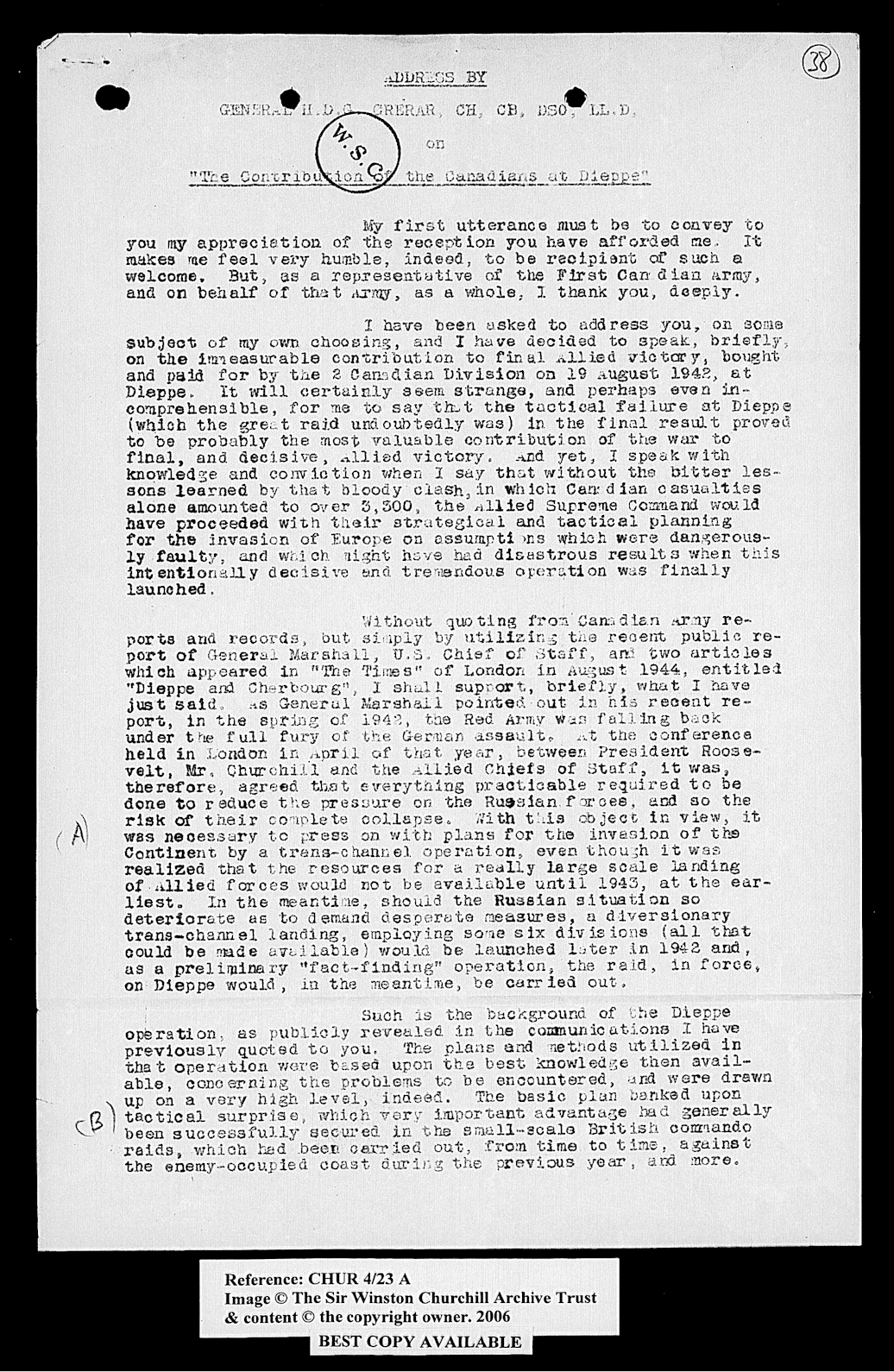
I have been asked to address you, on some subject of my own choosing, and I have decided to speak, briefly, on the immeasurable contribution to final allied victory, bought and paid for by the 2 Canadian Division on 19 August 1942, at Dieppe. It will certainly seem strange, and perhaps even incomprehensible, for me to say that the tactical failure at Dieppe (which the great raid undoubtedly was) in the final result proved to be probably the most valuable contribution of the war to final, and decisive, allied victory. And yet, I speak with knowledge and conviction when I say that without the bitter lessons learned by that bloody clash, in which Canadian casualties alone amounted to over 3,300, the Allied Supreme Command would have proceeded with their strategical and tactical planning for the invasion of Europe on assumptions which were dangerously faulty, and which might have had disastrous results when this intentionally decisive and tremendous operation was finally launched.
Without quoting from Canadian army reports and records, but simply by utilizing the recent public report of General Marshall, U.S. Chief of Staff, and two articles which appeared in "The Times" of London in August 1944, entitled "Dieppe and Cherbourg", I shall support, briefly, what I have just said. As General Marshall pointed out in his recent report, in the spring of 1942, the Red Army was falling back under the full fury of the German assault. At the conference held in London in April of that year, between President Roosevelt, Mr. Churchill and the Allied Chiefs of Staff, it was, therefore, agreed that everything practicable required to be done to reduce the pressure on the Russian forces, and so the risk of their complete collapse. With this object in view, it was necessary to press on with plans for the invasion of the Continent by a trans-channel operation, even though it was realized that the resources for a really large scale landing of Allied forces would not be available until 1943, at the earliest. In the meantime, should the Russian situation so deteriorate as to demand desperate measures, a diversionary trans-channel landing, employing some six divisions (all that could be made available) would be launched later in 1942 and, as a preliminary "fact-finding" operation, the raid, in force, on Dieppe would, in the meantime, be carried out.
...
Indeed, as the means of obtaining overwhelming fire support, when closing the beaches, were then not available, nor even invented, tactical surprise was the only possible basis on which to plan. In the result, tactical surprise was in no way obtained, and the rest of that day's story, all the world knows.
But, if, by a one hundred per cent combination of all the circumstances turning out in our favour, the Canadian raid on Dieppe had proved a cheap and easy success, what then? Well, no man can be positive about the "might-have-beens," but there is sufficient official evidence now made public to picture the extremely probable course of events. That course would have taken the form of an allied invasion of the Continent, a truly decisive operation of war, one way or another, without any adequate conception of the potential difficulties to be met, and overcome, launched with quite inadequate means, with insufficient forces and far too soon.
The lessons of Dieppe definitely prevented any such faulty allied strategy and tactics. I quote from the London Times when I say "The heavy sacrifices of the Canadians were not made in vain. The gallant lives were not thrown away. In the months that followed, the study of the experiences at Dieppe made more and more discoveries and confirmed more and more conclusions till a technique was developed, which was first demonstrated by the 3rd Canadian Division (in a large scale exercise) in October 1943. " This technique was adopted, and employed, by the allied assault forces, which included that 3rd Canadian Division, in the greatest combined operation of all time, which took place on 6 June 1944.
...
I would like to speak to you briefly about the immeasurable contribution to the Allied victory, paid for by the sacrifice of the 2nd Canadian Division on 19 August 1942 at Dieppe. It might seem strange for me to say that the failure of the raid at Dieppe was a valuable contribution to the final allied victory. But without the bitter lessons learned from that bloody clash — in which over 3,300 Canadians were killed, wounded, or captured — Allied leaders might have based their plans for invading Europe on dangerously false assumptions, with possibly disastrous results when the decisive operation was finally undertaken.
In the spring of 1942, the Red Army was falling back under the full fury of the German assault. The Allies therefore agreed that everything possible should be done to reduce the pressure on the Russian forces, although we did not yet at that point have the resources for a large scale landing of Allied forces. In the meantime, a trans-channel landing would be launched later in 1942 to distract the Germans, and the raid on Dieppe would serve as a preliminary "fact-finding" mission for this.
At the time of the Dieppe raid, the Allies did not yet have the weapons or techniques needed to provide massive supporting fire (from ships, aircraft, or artillery) to protect troops as they landed on the beaches. Instead, we banked on surprising the Germans. But in the end, surprise was in no way obtained, and the rest of that day's story, all the world knows.
If the Dieppe raid had gone perfectly and seemed an easy victory, we might have drawn all the wrong conclusions. We would probably have tried to invade Europe far too soon, without enough troops or equipment, and without realising how difficult such an operation would be. That could have led to disaster.
But the failure at Dieppe stopped that from happening. The lessons we learned there showed us what had to be changed. As The Times newspaper said, "The heavy sacrifices of the Canadians were not made in vain. The gallant lives were not thrown away.” From those experiences we developed the right techniques for large-scale landings and used successfully in the great invasion of Europe on 6 June 1944.
This is a record of a speech made by General Henry Duncan Graham Crerar, a senior Canadian army officer who commanded the First Canadian Army during the Second World War. He led Canadian forces in northwest Europe after D-Day.
The document does not record exactly where or when Crerar delivered the speech, but it was certainly before August 1948, when he sent a copy to Lord Louis Mountbatten (a senior British naval commander during the war) to help Mountbatten prepare for a similar speech. Mountbatten later sent a copy to Winston Churchill in September 1948.
The speech discusses an Allied raid on Dieppe (a port on the northern coast of France) on 19 August 1942, almost two years before D-Day. The purpose of this raid, code-named ‘Operation Jubilee’ was to launch an amphibious assault on the German-occupied port and to hold the town and port briefly, in order to and test whether a direct attack on an enemy-held port was feasible. The plan included landings on six separate beaches, of which all but one failed. Around 6,000 troops took part, largely from the Canadian 2nd Infantry Division, supported by British commandos and a small number of American forces.
Remember we are investigating why the Normandy Landings were such a remarkable achievement. The Dieppe raid, which this source refers to, took place almost two years before D-Day. The raid was widely seen as a failure, so this source helps us understand the general challenges the Allies faced in planning an invasion of France. It also shows us what might have happened if the invasion had been attempted without the extra two years of planning and preparation.
Which of the inferences below can be made from this source?
| On a scale of 1-5 how far do you agree that this source supports this inference? | Which extract(s) from the source support your argument? | |
|---|---|---|
| The raid on Dieppe was remembered as a moment of great Canadian sacrifice and tragedy. | | |
| The raid on Dieppe showed how difficult an invasion of northern France would be. | | |
| Dieppe showed that the Allies were not prepared for a full-scale invasion in 1942. | | |
| The raid on Dieppe was a complete disaster. | | |
➜ Download table (PDF)
➜ Download table (Word document)
Explore the guide to interpreting letters
➜ Source 5


