
Churchill Archive for Schools - Themes_Key questions_Normandy_Landings
Loading
Loading

Why were the Normandy Landings such a remarkable achievement for the Allies?

Source 5

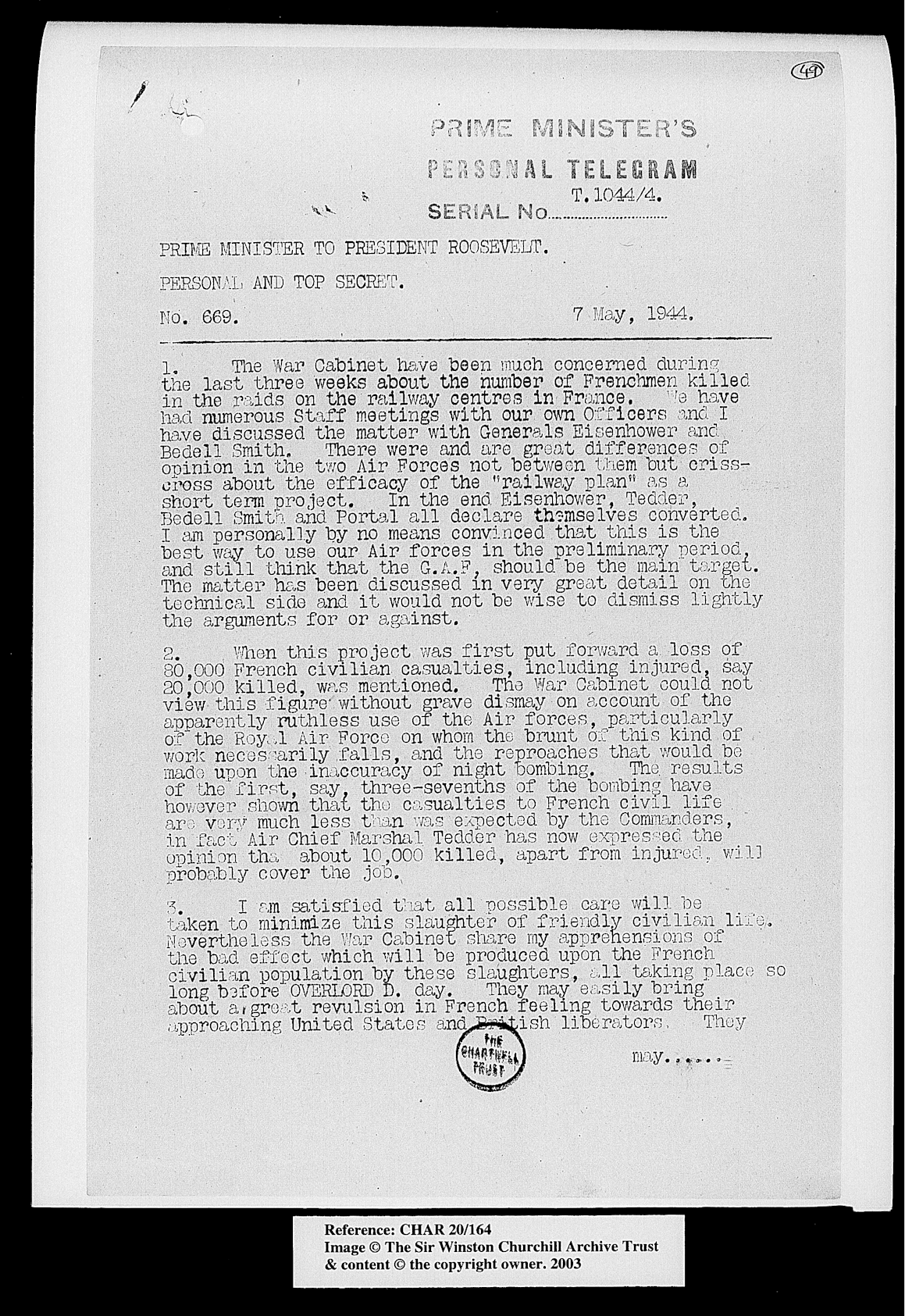
Extracts from a telegram sent to President Roosevelt of the USA from Churchill on 7 May 1944.

Reference

➜ CHUR 20/164/49-50


Transcript

[Page 42]

...

  1. The War Cabinet have been much concerned during the last three weeks about the number of Frenchmen killed in the raids on the railway centres in France.
    ...
  2. When this project was first put forward a loss of 80,000 French civilian casualties, including injured, say 20,000 killed, was mentioned. The War Cabinet could not view this figure without grave dismay on account of the apparently ruthless use of the Air forces, particularly of the Royal Air Force on whom the brunt of this kind of work necessarily falls, and the reproaches that would be made upon the inaccuracy of night bombing. The results of the first, say, three-sevenths of the bombing have however shown that the casualties to French civil life are very much less than was expected by the Commanders, in fact Air Chief Marshal Tedder has now expressed the opinion that about 10,000 killed, apart from injured, will probably cover the job.
  3. I am satisfied that all possible care will be taken to minimize this slaughter of friendly civilian life. Nevertheless the War Cabinet share my apprehensions of the bad effect which will be produced upon the French civilian population by these slaughters, all taking place so long before OVERLORD D. day. They may easily bring about a great revulsion in French feeling towards their approaching United States and British liberators. They may leave a legacy of hate behind them.
    ...
  4. Accordingly they ask me to invite you to consider the matter from the highest political stand-point and to give us your opinion as a matter between Governments. It must be remembered on the one hand that this slaughter is among a friendly people who have committed no crimes against us, and not among the German foe with all their record of cruelty and ruthlessness. On the other hand we naturally feel the hazardous nature of Operation OVERLORD and are in deadly earnest about making it a success. I have been careful in stating this case to you to use only the most moderate terms, but I ought to let you know that the War Cabinet is unanimous in its anxiety about these French slaughters, even reduced as they have been, and also in its doubts as to whether almost as good military results could not be produced by other methods. Whatever is settled between us, we are quite willing to share responsibilities with you.

Simplified Transcript

  1. The War Cabinet have been much concerned during the last three weeks about the number of Frenchmen killed in the bombing raids on the railway centres in France.
  2. When bombing the railways was first proposed, it was estimate that there would be around 80,000 French civilian casualties, including around 20,000 deaths. The War Cabinet found that figure deeply distressing because it implied heavy, ruthless use of the Air Forces—particularly the RAF, which must carry most of this work—and this would lead to criticism of the inaccuracy of night bombing. However, the results so far indicate civilian casualties are much lower than commanders expected. Now, a more likely estimate is that 10,000 will be killed.
  3. I am confident that all possible care will be taken to minimise the slaughter of friendly civilians. Still, the War Cabinet share my concern about the harmful effect these killings – occurring so long before D-day – may have on French public opinion. They could push the French population to resent the American and British forces when they arrive and leave a lasting legacy of hatred.
  4. The War Cabinet are extremely anxious about the French losses, even at the reduced estimates. But they also doubt whether good military results can be achieved by other methods. We would therefore welcome your view about whether to continue with the bombing. On one hand, we must remember that these deaths are among a friendly people who have committed no crimes against us, not among the German enemy with their record of cruelty. But on the other hand, we fully recognise how risky Operation OVERLORD is and are determined to make it succeed. Whatever is decided, we are willing to share responsibility with you.

What is this source?

This is a telegram from Prime Minister Winston Churchill to the President of the US (Franklin D. Roosevelt) on 7 May 1944. It discusses the ‘Transportation Plan’, which was the Allied bombing of railway hubs (train connection points) and marshalling yards (places where goods trains are sorted and arranged) in northern France in the run-up to D-Day.

Background to this source

By early 1944, the Allies had developed an air strategy to support the upcoming D-Day invasion, known as the ‘Transportation Plan’. This plan aimed to disrupt German troop movements and supply lines by bombing railway hubs and marshalling yards in northern France, where German troops and equipment were concentrated. The intention was to slow down German reinforcements, giving Allied forces crucial time to secure their initial positions after they captured the Normandy beaches. Many of these railway targets were located in densely populated towns.

How can we use this source in the investigation?

Remember, we are investigating why the Normandy Landings were such a remarkable achievement, including the risks involved in planning and executing them. This source helps us see the difficult decisions faced by the Allies as well as well as the gambles they had to take. It shows the factors they had to weigh—both immediate military objectives and potential long-term consequences—when deciding how to use their air power. It can help us to understand the range of considerations the Allies had to take into account, both in the short-term and the long-term.

Surface level: details, facts and figures

  1. What does Churchill say the War Cabinet has been worrying about?
  2. How many civilian deaths were originally estimated from the Allied bombing of the railway centres? What was the later, revised estimate?
  3. Who did the War Cabinet expect would be blamed for this bombing and resulting casualties?
  4. Besides the civilian deaths, what else does Churchill fear might result from heavy bombing of civilian areas?
  5. What two factors was the War Cabinet weighing up when deciding whether to continue the bombing strategy?

Deeper level: inferences and using the source as evidence

Which of the inferences below can be made from this source?

On a scale of 1-5 how far do you agree that this source supports this inference? Which extract(s) from the source support your argument?
The War Cabinet were very torn about the decision to carry on with the Transportation Plan.

Operation Overlord relied completely on the Transportation Plan.

Churchill thought that once the Allies had liberated France, the French people would forgive them for the bombing raids.

Churchill was more worried about what the French would think of the RAF and the British than about the civilian deaths themselves.


Need help interpreting the source?

  • Why is Churchill writing to Roosevelt — what help or guidance does he want? Churchill describes the War Cabinet (which is made up of Churchill and other senior ministers) as ‘concerned’ and ‘extremely anxious’ about civilian deaths, ‘even at the reduced estimates.’ But he also notes that they question whether the same results could be achieved ‘by other methods.’ Based on this, does it sound like the War Cabinet has already made a decision, or are they still unsure?
  • According to Churchill, would stopping the bombing of the railway centres increase or reduce the risk involved in Operation Overlord? Has the War Cabinet completely ruled out other ways of achieving the same military results?
  • Churchill notes that the bombing is happening ‘so long before D-Day,’ so the French may not understand the reason and might see it as pointless. He warns it could ‘leave a lasting legacy of hatred’ for the British and Americans. Does it sound like he expects the French to forgive the Allies eventually, or is he worried about lasting resentment?
  • Churchill uses strong words like ‘slaughter’ to describe civilian deaths. He also reminds Roosevelt that the civilians ‘have committed no crimes against us’ and are not ‘the German enemy with their record of cruelty.’ How does his concern about civilian deaths compare with his concern for the reputation of the RAF and the British?

Explore the guide to interpreting telegrams

 Source 6

 Back to sources page

 Back to investigation page